Suzdal in the 10th-15th centuries
M. V. Sedova
- Title
- Suzdal in the 10th-15th centuries
- Original Title
- Суздаль в X–XV веках
- Publication
- Moscow: Russkiy Mir, 1997, 236 p. + 40 plates (М.: Информационно-издательское агентство «Русский мир», 1997. 236 с. + 40 л. ил.)
- Original Language
- RU
- Author
- M. V. Sedova (М.В. Седова)
- Year
- 1997
- Publisher
- Russkiy Mir, Moscow
- ISBN
- 5-85810-032-5
- Website
- Open external link
Images
Texts from this Source
Original text (RU):
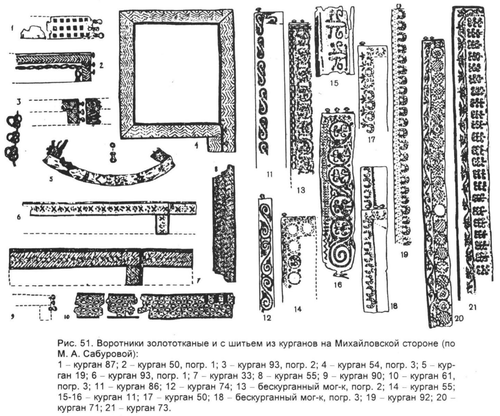
Каждый воротник с шитьем является произведением прикладного искусства, не уступающим ювелирным изделиям. В качестве примера можно привести воротник женского погребения 1 из кургана № 50 (рис. 51, 2). Основным полем воротника являлась шелковая ткань (самит) синего цвета. Сверху ткани и по ее разрезу слева была пришита лента с геометрическим орнаментом. Золото ленты, ее контраст с синей тканью был подчеркнут красной обшивкой ворота и красным шнурочком, пришитым под лентой. Обшивка сделана тафтой, а шнурочек скручен из шелковых ниток и пришит вертикальными стежками. Под красным шнурочком на фоне синего шелка была уложена золотая спиралька (канитель) в орнамент типа плетенки. Ворот был подложен берестой и поэтому не потерял форму.
English translation (AI generated):
Every embroidered collar is a work of applied art that yields nothing to the goldsmith's work. As an example one may cite the collar from female burial 1 of kurgan 50 (fig. 51, 2). The main field of the collar was blue silk (samite). Above the fabric and along its slit on the left a band with geometric ornament was sewn on. The gold of the band, and its contrast with the blue fabric, was emphasised by the red edging of the neck opening and by a red cord sewn on beneath the band. The edging is of taffeta, and the cord is twisted from silk threads and sewn on with vertical stitches. Beneath the red cord, against the blue silk, a gold spiral (kanitel) was laid in an interlace-type ornament. The collar was backed with birch bark and therefore did not lose its shape.