Suzdal, kurgan 93, burial 2
Grave from Suzdal
Notes
Posaments in grave Suzdal, kurgan 93, burial 2
Images
Images showing objects from Suzdal, kurgan 93, burial 2:
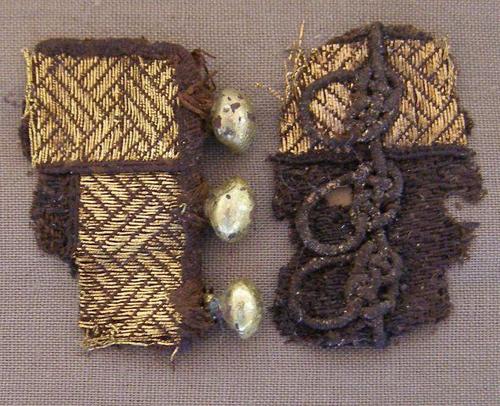
Grave Suzdal, kurgan 93, burial 2 showing Posament: suzdal
Image details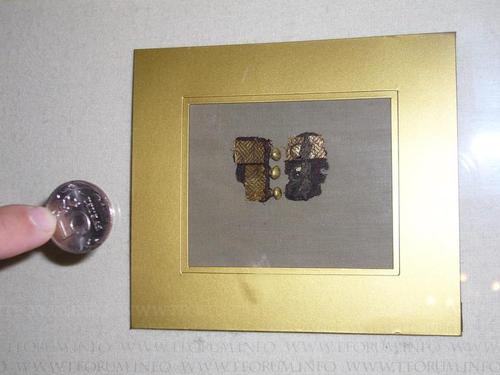
Grave Suzdal, kurgan 93, burial 2 showing Posament: suzdal
Image details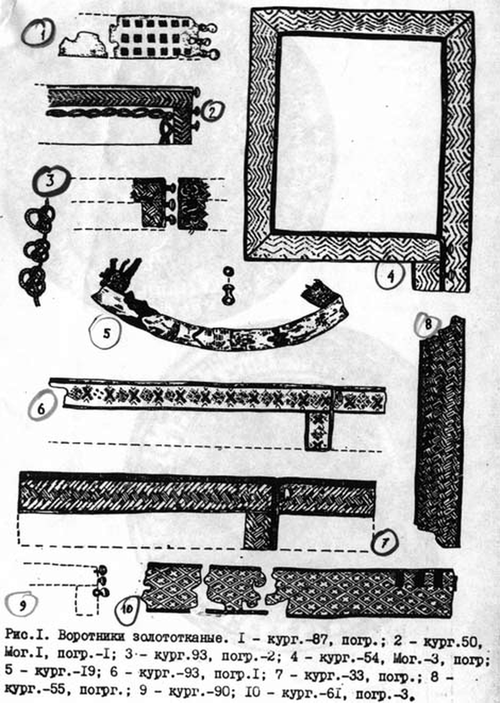
Grave Suzdal, kurgan 93, burial 2 showing Posaments: suzdal, suzdal50
Image details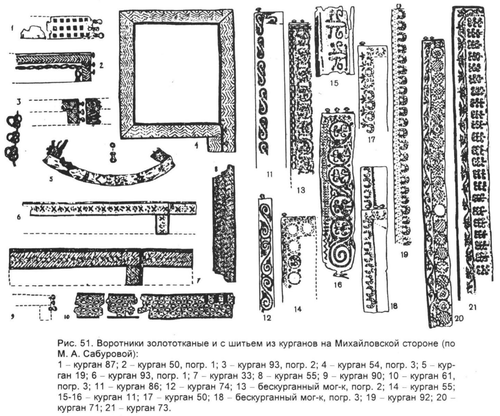
Grave Suzdal, kurgan 93, burial 2 showing Posaments: suzdal, suzdal50
Image details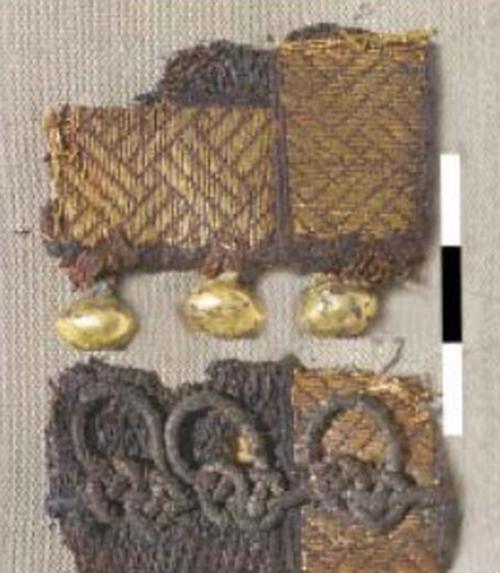
Grave Suzdal, kurgan 93, burial 2 showing Posament: suzdal
Image details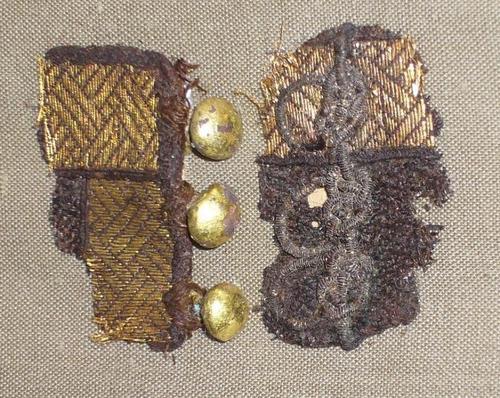
Grave Suzdal, kurgan 93, burial 2 showing Posament: suzdal
Image detailsTexts
Source texts referencing this grave
Original text (RU):
Для шитья и оформления петель использовали золотную нить «трунцал», накрученную тугой спиралью на толстую шелковую нить (погребение 2 кургана № 93 — сохранились петли, сплетенные в технике «макраме»).
English translation (AI generated):
For the sewing and for forming the loops they used the gold thread «trunzal» - spiral gold thread - wound in a tight spiral onto a thick silk thread (burial 2 of kurgan no. 93 - the loops, plaited in the "macramé" technique, are preserved).
Source texts referencing this grave
Original text (RU):
11. В женском погребении 2 (в кургане - 93) обнаружены 2 фрагмента воротника, размером 4 х 3 см с хорошо сохранившейся застежкой. Воротник сделан из шелка синего цвета и украшен каймой из золототканой ленты по верху его разреза. Слева ворота пришиты 3 полые пуговицы с петельками из позолоченной бронзы. Они примыкали к петлям из золотного трунцала, выложенным в виде трех плоских узлов. Орнамент ленты - плетенка. Лента обшита тафтой красного цвета, под ней сохранилась кожаная основа воротника (рис. 1, 3). В погребении найдены 2 перстневидных височных кольца из бронзы с заходящими концами. В области черепа при просмотре материала под микроскопом, обнаружен тлен красного цвета, содержащий микрофрагменты ткани полотняного переплетения (редина).
English translation (AI generated):
11. In female burial 2 (in kurgan 93) two fragments of a collar were found, measuring 4 x 3 cm, with a well-preserved fastening. The collar is made of blue silk and decorated along the upper edge of its opening with a border of gold-woven band. Three hollow buttons with eyelets, of gilded bronze, are sewn to the left of the neck opening. They met loops of gold spiral thread (truntsal) laid out in the form of three flat knots. The ornament of the band is an interlace. The band is edged with red taffeta, and beneath it the leather foundation of the collar survived (fig. 1, 3). In the burial two ring-shaped temple rings of bronze with overlapping ends were found. In the area of the skull, on examination of the material under the microscope, red decayed matter was found, containing microfragments of a plain-weave textile (redina, an open weave).
Source texts referencing this grave
Original text (RU):
Среди различных способов украшения шелковых тканей встречено и шитье трунцалом, т.е. золотной нитью, накрученной тугой спиралью на толстую шелковую основу. Трунцалом вышита простейшая плетенка на воротнике из погребения 1 кургана 50. Плетенка образована двумя спиралями и напоминает как бы растянутую веревочку. Она пришита к ткани шелковой нитью «в прикреп». В женском погребении 2 кургана 93 из трунцала сплетены петли для застежки воротника.
English translation (AI generated):
Among the various ways of decorating silk fabrics, embroidery with spiral gold thread (truntsal) also occurs, that is, with a gold thread wound in a tight spiral onto a thick silk core. The simplest interlace was embroidered in spiral gold thread on the collar from burial 1 of kurgan 50. The interlace is formed by two spirals and resembles a stretched-out cord. It is attached to the fabric with silk thread in couching. In female burial 2 of kurgan 93 the loops for the collar fastening are plaited from spiral gold thread.
Source texts referencing this grave
Original text (RU):
Публикуемые в статье материалы являются деталями одежды, большинство из которых представляют из себя фрагменты воротников. Они извлечены из погребений кон. XI - сер. XII вв. на некрополе г. Суздаля. Раскопки производились в 1974-1982 гг. За этот период раскопано 100 курганов и территория некрополя с уничтоженными насыпями («Бескурганный могильник»).
English translation (AI generated):
The material published in this article consists of details of clothing, most of them fragments of collars. They were recovered from burials of the end of the 11th to the middle of the 12th century at the necropolis of the town of Suzdal. The excavations were carried out in 1974-1982. In that period 100 kurgans were excavated, together with the area of the necropolis whose mounds had been destroyed (the "flat cemetery").
Source texts referencing this grave
Original text (RU):
Каждый воротник с шитьем является произведением прикладного искусства, не уступающим ювелирным изделиям. В качестве примера можно привести воротник женского погребения 1 из кургана № 50 (рис. 51, 2). Основным полем воротника являлась шелковая ткань (самит) синего цвета. Сверху ткани и по ее разрезу слева была пришита лента с геометрическим орнаментом. Золото ленты, ее контраст с синей тканью был подчеркнут красной обшивкой ворота и красным шнурочком, пришитым под лентой. Обшивка сделана тафтой, а шнурочек скручен из шелковых ниток и пришит вертикальными стежками. Под красным шнурочком на фоне синего шелка была уложена золотая спиралька (канитель) в орнамент типа плетенки. Ворот был подложен берестой и поэтому не потерял форму.
English translation (AI generated):
Every embroidered collar is a work of applied art that yields nothing to the goldsmith's work. As an example one may cite the collar from female burial 1 of kurgan 50 (fig. 51, 2). The main field of the collar was blue silk (samite). Above the fabric and along its slit on the left a band with geometric ornament was sewn on. The gold of the band, and its contrast with the blue fabric, was emphasised by the red edging of the neck opening and by a red cord sewn on beneath the band. The edging is of taffeta, and the cord is twisted from silk threads and sewn on with vertical stitches. Beneath the red cord, against the blue silk, a gold spiral (kanitel) was laid in an interlace-type ornament. The collar was backed with birch bark and therefore did not lose its shape.
Source texts referencing this grave
Original text (RU):
48. Пуговицы. XI–XIII вв. Сплав медный, литьё, золочение 0,9×0,5×0,5; 0,9×0,6×0,6; 0,9×0,5×0,5 В-43505/17. АС-3904 Описание: три двояковыпуклые цельнолитые пуговицы, с петлевидными ушками, поверхность покрыта позолотой; пришиты к краю воротника. Сохранность: патинированы, мелкие утраты позолоты. Место и дата раскопок: г. Суздаль, Мжарский могильник, 1976–1981 гг. Автор раскопок: Сабурова М.А.
English translation (AI generated):
48. Buttons. 11th-13th century. Copper alloy, cast, gilded 0.9 x 0.5 x 0.5; 0.9 x 0.6 x 0.6; 0.9 x 0.5 x 0.5 V-43505/17. AS-3904 Description: three biconvex solid-cast buttons with loop-shaped eyelets, the surface covered with gilding; sewn to the edge of a collar. Condition: patinated, small losses of gilding. Place and date of excavation: town of Suzdal, Mzhary cemetery, 1976-1981. Excavator: M. A. Saburova.